
Blog
OEM vs Aftermarket Turbochargers: Which Fits?

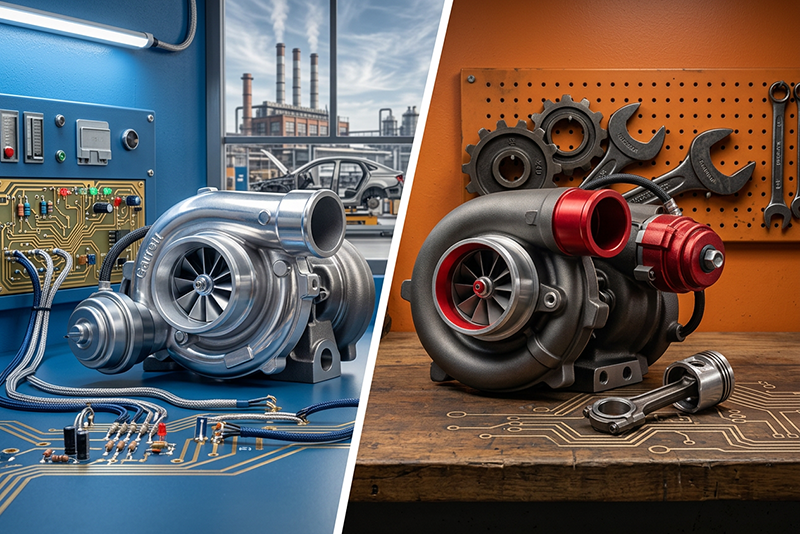
A failed turbo can park a work truck faster than most operators expect. Once you are comparing OEM vs aftermarket turbochargers, the decision is not simply about the price on the invoice. The right choice depends on the engine platform, the truck’s workload, the cause of the original failure, and whether the replacement is built to match the controls and airflow demands of your application.
For a fleet truck that needs predictable fitment, an OEM unit may be the right call. For an older diesel, a properly engineered premium replacement or remanufactured turbo can deliver dependable service at a lower cost. What matters is buying the correct turbocharger, installing it correctly, and correcting the problem that damaged the original unit.
OEM vs Aftermarket Turbochargers: The Real Difference
OEM turbochargers are supplied by the original equipment manufacturer or produced to the original engine specification. In many cases, that means the unit matches the factory turbo model, turbine and compressor sizing, actuator strategy, sensor provisions, mounting points, and calibration requirements. On electronically controlled variable geometry turbochargers, that factory-level match can be especially important.
Aftermarket turbochargers cover a much wider category. Some are premium replacement units built by established manufacturers using application-specific components and close factory tolerances. Others are low-cost units built to a price with limited quality control, inconsistent balancing, questionable actuator setup, or materials that may not hold up under sustained exhaust temperatures.
That distinction matters. “Aftermarket” does not automatically mean poor quality, just as “OEM” does not guarantee the lowest total repair cost. The real comparison is OEM versus a proven, correctly matched aftermarket or remanufactured unit. A bargain turbo with unknown sourcing is not the same product as a tested replacement assembled for a Cummins, Power Stroke, Duramax, Detroit, Caterpillar, Volvo, or Paccar application.
When an OEM Turbo Is Worth the Cost
An OEM turbo is often the safest choice when the truck is newer, still under manufacturer coverage, or uses a complex electronic VGT system. These systems rely on accurate vane movement and actuator communication to control boost, exhaust backpressure, emissions operation, and engine protection strategies. A mismatch can set fault codes, reduce power, trigger derates, or create repeated actuator issues.
OEM is also a strong option when exact fitment is non-negotiable. A commercial truck that has to return to service quickly may not have time for bracket modifications, clocking adjustments, connector concerns, or questions about whether an actuator is calibrated for the truck’s VIN-specific configuration. The higher upfront cost can make sense when it prevents extra labor and downtime.
For fleets with standardized maintenance policies, OEM parts can simplify purchasing and repair records. If every truck receives the same approved component, technicians know what to expect and managers can better track service life across the fleet.
Still, OEM is not automatically necessary for every repair. On a truck outside factory coverage, particularly one with substantial miles and a cost-sensitive repair budget, a quality remanufactured or premium replacement turbo may be the better business decision.
Where Premium Aftermarket and Reman Turbos Make Sense
A premium aftermarket turbocharger can offer a practical balance of cost, availability, and reliability. This is particularly true when the manufacturer builds the unit for the exact engine and vehicle application rather than offering a universal substitute. Correct flange patterns, oil feed location, drain geometry, compressor housing orientation, wastegate or VGT configuration, and actuator compatibility should all be verified before ordering.
Remanufactured turbochargers can also be a sound repair option when the rebuilding process is done correctly. A legitimate reman unit is more than a cleaned-up used turbo. The center housing rotating assembly should be inspected, critical wear components replaced, and the rotating assembly balanced to specification. Housings must be checked for damage, and variable vane mechanisms need to move freely and be set up for their intended application.
The key word is quality. A reman turbo built with advanced testing and balancing procedures can be a dependable replacement. A rebuilt turbo with no documented process, no meaningful warranty, and no support after the sale creates risk for the installer and the truck owner.
At American Diesel Parts, the focus is on application-ready diesel components backed by technical support and a 12-month limited warranty. That is the standard to look for whether you choose OEM, remanufactured, or premium replacement parts: correct application data, traceable quality controls, and support when the repair needs a second set of experienced eyes.
Fitment and Calibration Matter More Than the Box
A turbocharger is not a standalone air pump. It works with the engine’s fuel system, exhaust system, charge-air cooler, sensors, EGR system, and engine calibration. Installing a turbo that physically bolts on but does not match the engine’s airflow and control requirements can cause problems that look like a defective part.
This is most common with variable geometry units. Many late-model diesel engines use electronic actuators that must be matched, programmed, or calibrated correctly. Installing an actuator from a similar-looking turbo does not guarantee it will operate correctly with the vehicle’s ECM. The result may be slow spool-up, overboost or underboost codes, poor exhaust brake operation, or a no-power complaint under load.
Before buying, confirm the engine serial number, vehicle year, model, emissions configuration, turbo part number, and actuator details. On heavy-duty equipment, a truck model alone is not always enough. Midyear production changes and engine-family differences can make two nearly identical-looking turbos incompatible.
Do Not Replace the Turbo Until You Find the Failure Cause
A turbocharger rarely fails without a reason. Replacing the unit without identifying that reason can turn a one-time repair into a comeback. The new turbo may fail quickly, and the warranty may not cover damage caused by contamination, oil starvation, excessive exhaust temperatures, or foreign material.
Inspect these areas before installation:
- The oil supply and drain system for coking, restrictions, leaks, damaged lines, or poor oil pressure
- The intake tract, air filter, charge-air cooler, and piping for dirt ingestion, loose clamps, debris, or compressor-wheel damage
- The exhaust system for restrictions, broken hardware, manifold leaks, and excessive backpressure
- The fuel and air management systems for injector problems, boost leaks, EGR faults, or tuning that drives exhaust temperature beyond safe limits
Oil contamination is one of the most common causes of repeat turbo damage. If the old turbo failed due to bearing damage, inspect the oil feed line carefully. Reusing a restricted or carboned-up feed line can destroy the replacement unit. The same applies to a blocked oil drain. A turbo needs clean, pressurized oil entering the bearing housing and a clear path for oil to return to the crankcase.
Foreign-object damage deserves the same attention. A broken compressor wheel can send material into the charge-air system. If the intercooler and pipes are not cleaned or replaced as needed, debris can enter the new turbo or engine. Skipping this step to save time is expensive.
Comparing Cost the Right Way
The purchase price is only one part of turbo cost. Consider the labor to access the turbo, the price of gaskets and installation hardware, the need for an oil line or actuator, the cost of downtime, and the risk of a repeat repair. A cheaper unit that lasts six months is not cheaper if the truck has to be torn down twice.
For an owner-operator, a premium replacement turbo may preserve needed cash while still providing dependable performance. For a fleet that loses revenue every hour a truck is down, OEM fitment and fast installation can justify the additional part cost. For a repair shop, the best choice is the part that fits correctly, performs as intended, and protects the shop from unnecessary warranty labor.
Ask direct questions before ordering. Is the turbo new, remanufactured, or rebuilt? Is the actuator included and properly matched? What components are replaced during remanufacturing? What warranty applies? Does the supplier confirm fitment by engine information and part number? Straight answers help prevent wrong-part delays.
Make the Replacement Last
A good turbo installation starts with clean oil, clean air, clean mating surfaces, and correct hardware. Prime the turbo with clean engine oil as specified for the application. Do not use excess sealant where it can break loose and restrict an oil passage. Replace damaged feed lines, use new gaskets where required, and verify that all intake and charge-air connections are secure.
After startup, check for oil leaks, exhaust leaks, boost leaks, unusual noise, and fault codes. Let the engine idle long enough to verify oil pressure and normal operation before putting it under load. Then road-test or load-test the truck while monitoring boost response and engine performance.
The best solution is not always the most expensive turbocharger. It is the correctly matched unit from a supplier that understands diesel applications, backed by a repair process that addresses why the original turbo failed. Buy for the engine, the workload, and the repair standard your truck needs – then give the new turbo clean oil and clean air to earn its service life.